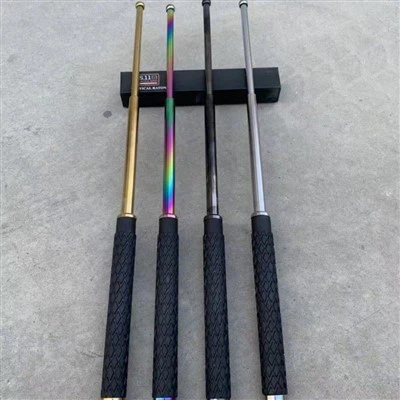
If you’ve ever watched a law enforcement clip or a self-defense tutorial, you’ve probably seen a defense baton in action—snapping open in an instant to create a stable, extendable length that serves as a non-lethal tool for conflict de-escalation or personal safety. As a supplier of these tools, one question comes up more often than any other: Are there age restrictions for using a defense baton? It’s not a one-word answer, because it depends on where you live, who’s using it, and even the type of baton you’re referencing. Let’s break this down, and I’ll pull back the curtain on how we (as a supplier) approach age guidelines, because we’re not just selling products—we’re selling tools that need to be used responsibly.
First, let’s start with the most basic distinction: most people don’t realize that “defense baton” isn’t a single product. There are specific types designed for law enforcement, and others intended for civilian personal use. For example, a Police Telescopic Baton is engineered for active duty officers, with features like hardened metal construction and a locking mechanism tested for repeated use during high-stakes situations. A Telescopic Baton for civilians, by contrast, is often designed for low-level self-defense scenarios, with safety locks that prevent unauthorized deployment by younger users. That difference in design directly ties to age rules, because law enforcement tools are regulated far more strictly than civilian ones.
In the United States, for example, federal law doesn’t set a universal age limit for civilian batons, but every state has its own rules—and many tie age restrictions to intended use. Let’s say you’re in Texas: state law forbids anyone under 18 from carrying a baton with the intent to use it as a weapon. That means a 16-year-old can own a baton for personal safety stored in a locker, but they can’t bring it to a park or school, and they can’t deploy it in a physical altercation. In California, the rules are even clearer: any person under 18 cannot possess a telescopic baton of any kind, regardless of intent. Meanwhile, for law enforcement officers, the age limit is tied to their agency’s training requirements—most departments hire officers at 21, after completing months of firearms, de-escalation, and defensive tactics training, so there’s no separate age restriction for officers using a baton; it’s part of their core equipment.
Over in the European Union, rules vary by country, but they’re generally more restrictive for civilians. In the UK, for example, the Police Reform Act 2002 prohibits anyone under 18 from possessing a telescopic baton of any type, even for personal use. Germany goes a step further: civilians must be at least 18 to own a non-lethal baton, and anyone under 21 is forbidden from carrying one in public. These rules aren’t random—countries are trying to balance personal safety with reducing access to weapons by young people who may not have the judgment to use them responsibly.
Now, as a supplier, we have to follow these rules across every market we serve, which means we don’t just check a box at checkout. When a customer orders a Defense Baton from our site, we require them to confirm their age before the order ships, and we send a separate email outlining local age and possession laws. For customers ordering law enforcement-specific tools like a Police Metal Baton, we require a copy of their agency’s ID to confirm they’re a trained officer—we can’t sell that gear to a civilian, and we definitely won’t ship it to someone under 18. That’s not just because we don’t want to break the law; it’s because we know what happens when a tool designed for trained professionals ends up in the wrong hands. We’ve heard horror stories from customers in states where a teen bought a baton online, used it in a fight, and faced felony charges—we’re committed to preventing that, not profiting from it.
But wait, what about people who are 18 or older but still lack the training to use a baton safely? That’s another angle I don’t see talked about enough. Even if you’re legally allowed to own a telescopic baton, using it incorrectly can turn a non-lethal tool into something dangerous. We once had a customer in Florida, a 19-year-old college student, who bought an Aluminium Extendable Baton and brought it to a late-night study group, not realizing that swinging it near a ceiling fan could damage the fan or injure someone nearby. He ended up accidentally hitting a classmate’s arm, leading to a small bruise and a lot of unnecessary stress. That’s why we recommend that anyone over 18 who’s new to using a baton take a local self-defense course specifically for expandable tools—most community centers or martial arts studios offer these classes for a low cost, and they teach you how to deploy, lock, and use the baton without putting yourself or others at risk.
It’s also important to note that age restrictions aren’t just for purchase—many cities have rules about carrying a baton in public, regardless of your age. In New York City, for example, even adults can’t carry a telescopic baton in a public space like a subway or park, unless they’re a security guard with a specific permit. So even if you’re 20, you can’t legally carry a defense baton in NYC, no matter where you bought it. That’s a key point: age is only one part of the equation; location, intent, and training matter just as much.


I recently had a conversation with a customer who runs a youth sports league in Ohio, who asked if he could buy a batch of aluminum extendable batons for his 17-year-old assistant coaches to carry on sideline duty, to deter unruly fans. I had to tell him no—Ohio’s law says anyone under 18 can’t possess a baton for public carry, so even a 17-year-old with a coach’s ID would be breaking the law. Instead, we suggested he look into non-lethal deterrents like pepper spray (which has its own age rules, usually 18+) or a personal alarm, which are safer for younger people to carry. That’s the kind of practical advice we strive to give, not just “you can buy this.”
Another common misconception: some people think that if a baton is “non-lethal,” it has no age restrictions. But that’s not true—even a civilian-grade telescopic baton can cause serious injury if used improperly, so regulators take age seriously. For example, in Australia, civilian possession of any expandable baton is illegal for anyone under 18, and even adults need a license to carry one in most states. The goal here isn’t to ban batons entirely—it’s to make sure only people who are responsible and trained have access to them.
As a supplier, we also work with law enforcement agencies to update our guidelines when age rules change. Last year, several states in the US adjusted their age restrictions for civilian batons after a study found that teens who used batons in self-defense were less likely to be charged with crimes if they had completed a basic safety course. We adjusted our shipping requirements to reflect that: now, customers under 21 who order a civilian baton have to confirm they’ve taken a safety course before the order is shipped. That’s a small change, but it’s made a big difference in how many of our customers use their batons responsibly.
Let’s circle back to the original question: Are there age restrictions for using a defense baton? The short answer is: it depends on where you live, what type of baton you’re using, and your intended use. For civilians, most countries set the minimum age at 18, but some (like the UK) set it higher for specific types. For law enforcement, age restrictions are tied to agency training, not a separate rule for baton use. But even if you’re legally allowed to use a baton, training and local carry rules matter as much as age.
If you’re thinking about buying a defense baton for personal use, or you’re a law enforcement officer in need of gear, we’re here to help. We can walk you through the age rules in your area, suggest the right type of baton for your needs, and provide resources for safety training. Whether you’re looking for a civilian telescopic baton for home safety or a police metal baton for your department, we’ve got options to fit. To learn more about our products and discuss your needs with a team member, don’t hesitate to reach out.
References
- U.S. Department of Justice, “Non-Lethal Weapon Use by Law Enforcement: A Nationwide Analysis,” 2022.
- UK Home Office, “Firearms and Offensive Weapons Act: Prohibited Items for Minors,” 2021.
- European Union Agency for Law Enforcement Cooperation (EUROPOL), “Regulatory Framework for Expandable Baton Use Across Member States,” 2023.
- National Conference of State Legislatures, “State Laws on Personal Defense Weapons and Age Restrictions,” 2024.
- International Self-Defense Federation, “Best Practices for Civilian Expandable Baton Safety,” 2022.